
The bicycle-trail etiquette guide
This is how taking your bicycle on the train works without stress and hassle.
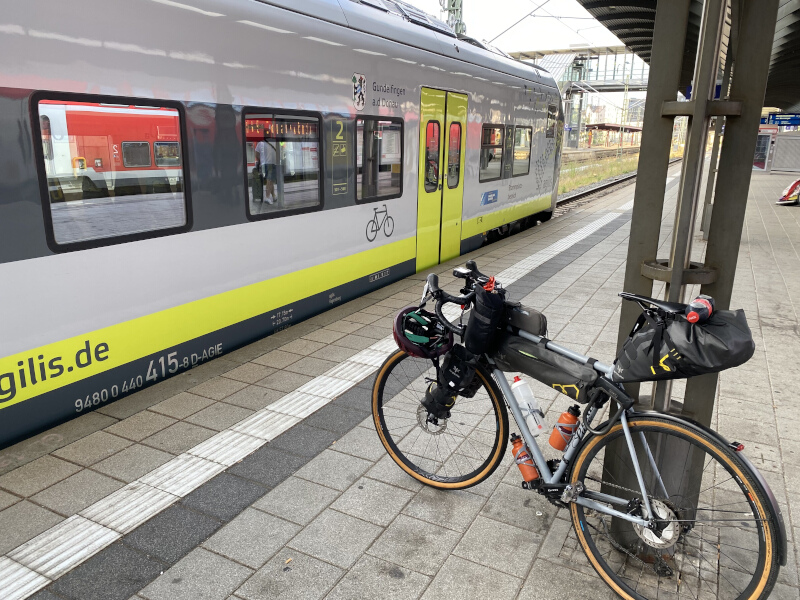
Bicycles on trains often lead to conflicts.
“Well, bravo! So much for a ‘relaxed tour’”
Have you ever tried taking your bike on the train on a beautiful summer weekend? Maybe even with your family? Things often get "hot" in more ways than one, and not just because the air conditioning isn't working. Space for bikes on the trains is limited, and there's often pushing, shoving, and squeezing.
Turn bringing your bike along into a positive experience: We support you with our expertise.
“Does it really have to be like this?” – No! It can work together.
We want to use our experience as passionate cycle tourists to help you make your journey stress-free and enjoyable. So how can we all contribute to turning the combination of cycling and train travel into a positive experience?
Preparation: Selecting the appropriate train and reserving bicycle parking spaces.
Trains requiring reservations in long-distance transport
- Find out early about the possibility of reserving bicycle parking spaces.
- Use specialized platforms for this, such as bahn.cyclebee.app.
- Avoid peak travel times if possible to reduce stress.
In regional transport, you usually have no option to reserve a bicycle space.
- Therefore, be sure to avoid peak times (cycling is often not even allowed at these times)
- Plan in extra time in case it turns out that you can't get a ride.
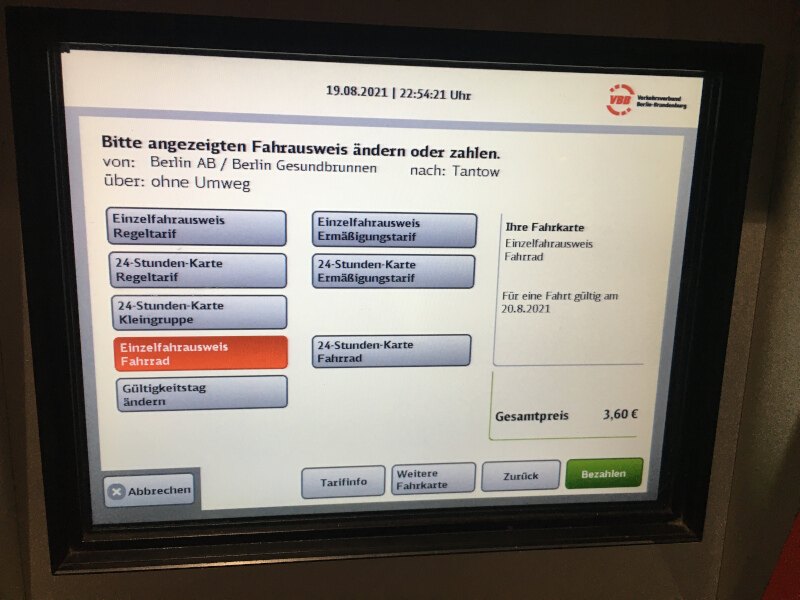
Photo: ©Markus Vogt
At the train station: Here's how to get to the train safely
The path to the platform sometimes resembles an obstacle course: age and limitations take precedence over youth and fitness.
- Show consideration when walking to the platform.
- Push your bicycle on the platform
- Respect priority for elevator access.
- The rule is: age and limitations take precedence over youth and fitness.
- Support each other. If you help carry the stroller up the stairs, your fellow travelers will surely help you with the luggage as well.
Behavior on the platform: Find allies early on
- Use the train status display (in the train app, ÖBB app…):
This is how you find the section where bicycle parking is provided. This saves you and your fellow passengers unnecessary crowding and searching in the last few meters before departure. On local trains, the bicycle compartments are often located in the first and last carriages. - Coordinate with other cyclists:
This way you can join in a sensible order. Small groups can also help to store bicycles more efficiently and support each other. - Remove bags and additional luggage before boarding or at the latest once on the train.:
This way you can speed up the process, keep aisles clear for subsequent passengers, and (hopefully) the train will depart on time. - Perfectly logical, but we would still like to emphasize it:
- Let people get off first, then get on.
- Public transport: When it's full, it's full (unfortunately, bicycles are at a disadvantage, but this rarely happens in reality).
- Children and people with mobility impairments always have priority!
Photo: ©Markus Vogt
Here's the best way to place your bicycle on the train.
Tip 1: Take off your bags!
Even though we're repeating ourselves: The most important act of solidarity when taking your bike on the train is to remove your panniers. If you're the first cyclist at the first station, you often think: Okay, there's plenty of space here, I don't need to take my panniers off.
However, especially in summer and spring, bicycle space on local public transport can often be scarce. If you, as someone taking your bike on the train, want to board at a later station and find the train packed with bicycles and panniers still attached, you're out of luck!
But this doesn't have to be the case, provided that the earlier entrants show due consideration for the later ones.
Taking off bags also means: More cyclists can enjoy the benefit of taking their bikes along!
Photo: ©Markus Vogt
Tip 2: Put bags on the shelf and not in the aisles.
Once you've taken off your bags, you should stow them in the overhead luggage rack. An Ortlieb or Vaude bag often fits without any problems in the luggage racks of DB, ÖBB, SBB, etc.
It's important to remember: the corridors are the emergency exits in case of an emergency. Therefore, it's crucial to keep them clear.
Tip 3: Position wheels facing each other to save space.
To save even more space and accommodate as many bicycles as possible on public transport, they should be parked facing each other. Simply placing the handlebars end to end takes up more space than placing them facing each other. Therefore, this is also a sign of consideration and allows more people to use the combined bicycle and train service, should it become crowded.
Tip 4: Use the reserved seat on the long-distance train.
It's a common occurrence that cyclists on trains interpret the reservation rules a bit too liberally. This might not work on an Intercity train (IC) outside of peak cycling season. However, on an ICE train with its limited 8 bicycle spaces, it often doesn't.
It's confusing and somewhat unfair when someone boarding later has a reserved seat but then has to ask where the other person has reserved one. Sometimes, seats aren't even reserved, leaving insufficient space. In these situations, train staff have to intervene.

Photo: ©Nillerdk, Bicycle compartment in the control car of DB InterCity 2, CC BY-SA 4.0

Tip 5: On long-distance trains, offer to swap seats if necessary.
In some cases, it's possible to swap places with someone. However, you should speak to the person beforehand and not simply take their spot. Especially if you have a lightweight racing bike, you can hang it up much faster than someone with a 25-kilo e-bike. Offering to swap places is perfectly acceptable in this situation.

Photo: ©Ra Boe / Wikipedia, ICE 4 -wheel compartment- 2018 by-RaBoe 003, CC BY-SA 3.0 DE

Tip 6: When using public transport, keep an eye on bicycles in case someone wants to get off in front of you.
There are no reserved seats on public transport. You should keep your bicycle in sight and not leave it unattended. Someone might want to get off in front of you, and you might have placed your bicycle in front of them.
Tip 7: Especially on local public transport, communicate the order in which passengers will be alighting. This saves time and stress for everyone.
What makes things easier for everyone is asking about the final stop beforehand. This allows bikes to be stacked according to the disembarkation point: the person getting off later has their bike at the bottom, while those getting off at the next stop should have theirs readily accessible in front of all the other bikes.

Photo: ©Markus Vogt
Tip 8: Always carry a tension strap or a small rope: This way you can secure the wheel.
Even though many local trains already offer it, a tension strap in your luggage or a small rope or cord can help to better secure your bike and thus reduce the risk of it falling over.
Tip #9: Help each other and stay fair.
Perhaps the most important tip of all: Always be supportive and fair. The cycling community usually helps each other out on trains, too. As a younger person, you can always help an older person lift their bike and hook it up.
Tip 10: If you're traveling on public transport without a bike: free up folding seats for cyclists.
Finally, even non-cyclists can contribute to making bicycle transport more pleasant. It's clear that wheelchair users and strollers always have priority over bicycles. However, the fold-down seats in the multi-purpose compartments should be made available when cyclists are approaching.

Photo: ©Markus Vogt
Conclusion: Communication and conflict resolution
Leaving all the rules aside, what ultimately helps is approaching the adventure of "taking your bike on the train" with an open, defensive, and communicative attitude. Our experience as bike tour checkers and at cyclebee shows that the vast majority of cyclists in the bike compartment are quite helpful to one another. Simply putting your bags away beforehand is more than half the battle.
Because one thing is certain: fairness, mutual assistance and considerate behavior are essential given the limited capacity for cyclists on trains.
Perhaps the major railway companies in Central Europe will further expand their capacities if demand for cycling holidays continues to rise. Until then, however, special consideration must be given to cyclists.
Dedicated bicycle carriages, like those in the ÖBB trains from Munich to Venice or those that exist occasionally in leisure traffic in Baden-Württemberg, are certainly a good solution to ease the situation.
We also want to encourage you to simply reserve a bike ticket and then, with a positive outlook, embark on the adventure of "bike & train". We are sure: It's the The future of tourism!
What do you think?
Tell us about your experiences taking your bicycle on the train.
Do you have any other tips? Or do you have a good example of how you and your partner managed to resolve a stressful bicycle-train situation? Share your story in the comments.
About the authors
We are Markus, the cycling tour checker, and Katrin from the cyclebee team.
Markus He cycles several thousand kilometers every year on the most popular cycle paths in Germany and Europe. In his blog radtouren-checker.de He describes his experiences and offers a great overview of the variety of tourist cycling routes. Naturally, this also regularly involves cycling on railway lines.
Also Katrin and our team The team at cyclebee are passionate cyclists themselves, traveling solo and with their families. Katharina, Matthias, Daniel, Hannes, and Katrin – want to encourage more people to use their bikes for holidays with their cycling app, cyclebee. To make combining cycling and train travel easier, our platform, cyclebeeOnRails, offers not only a wealth of general information on the topic but also the opportunity to rate train stations and connections based on their bike-friendliness.
cyclebeeOnRails – Your partner for taking your bicycle on the train
Want to travel comfortably and flexibly by bike and train? Then "cyclebeeOnRails" is the answer for you. Here we offer official data on connections and train stations, which you can supplement with comments, tips, and reviews. Over time, your feedback will create a vibrant knowledge platform for everyone who enjoys combining cycling and train travel.
Bus instead of train for the return journey:
Have you seen our bike bus guide yet?
Traveling to and from your cycling trip by train can be quite nerve-wracking and inconvenient.
Many popular cycling routes have dedicated bike shuttle services that transport you and your bicycle back to your starting point by bus and trailer. This often saves you the hassle of changing buses and the effort of carrying your bike.
Unfortunately, these bicycle buses are not always easy to find – especially if you don't know that there is a shuttle service for this cycle path.
For this reason, we have researched and compiled a list of bicycle buses in Austria and southern Germany for you. Bike bus guide summarized.
In addition to cycle path shuttles, our guide also includes regional leisure lines that you can use for planning day trips and star tours.
When I travel west from St. Pölten, I prefer the Westbahn railway.
There is a wide entry point and my bike (KTM e-bike) is secured right at the entrance without having to lift the bike.
I travel by train 2-3 times a year for a cycling trip.
Especially in Vienna, it unfortunately happens all too often that the fold-down seats in the bicycle compartment are occupied by passengers without bicycles. Some refuse to vacate the space for bicycles despite a polite request, even though there are plenty of other seats available on the train. Very annoying.
Yes, that is indeed annoying. You always have to hope that the train staff will intervene.